ChronoVision: Temporal Reasoning via Latent State Reconstruction
Abstract
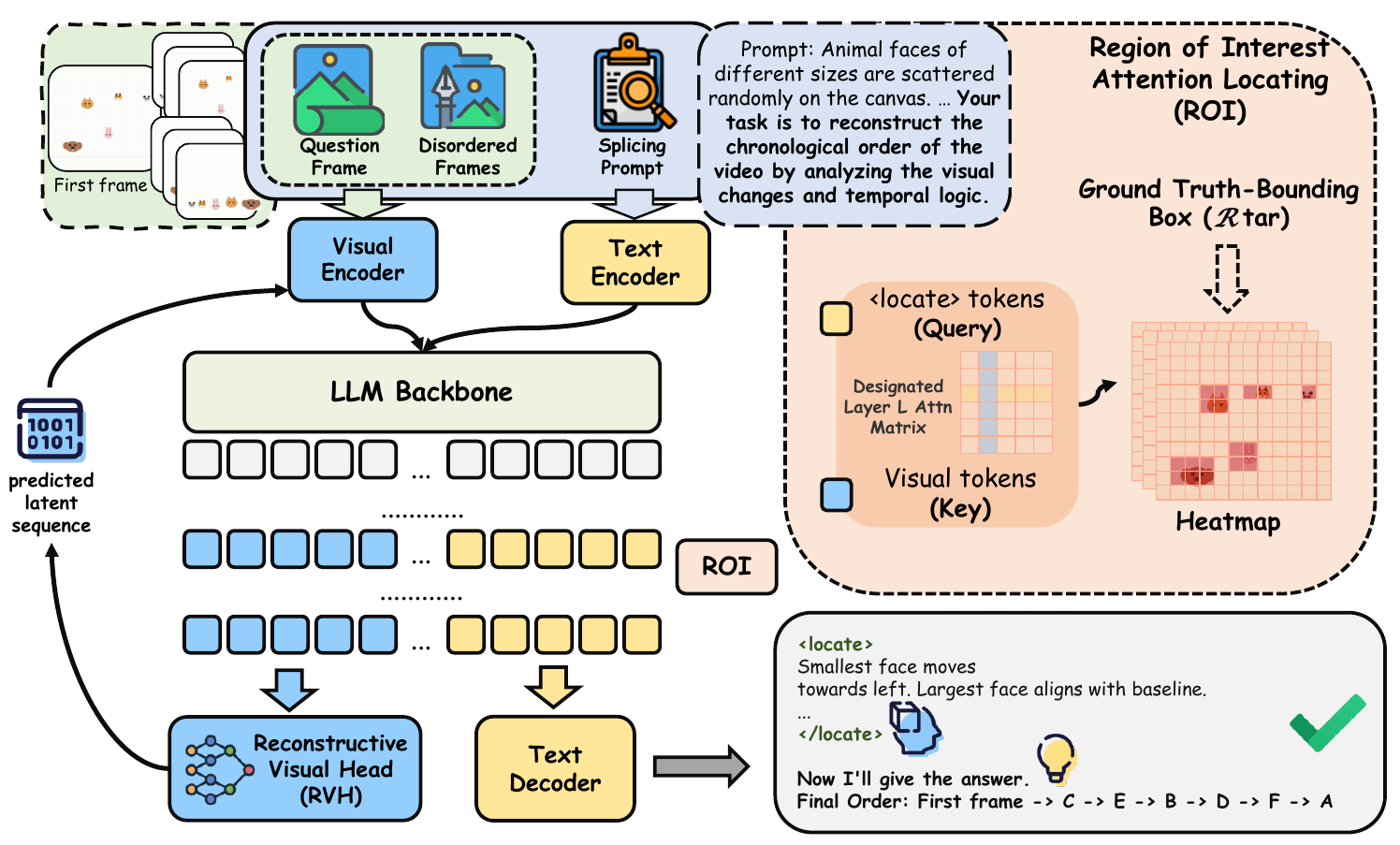
Multimodal large language models excel at passive perception but struggle with complex visual cognitive tasks requiring multi-step temporal reasoning. This degradation largely stems from the ambiguity of language-based reasoning, which often fails to accurately articulate continuous visual transformations. To address this, we propose ChronoVision, a multimodal framework designed to align visual logic with latent imagery. During supervised fine-tuning, a Reconstructive Visual Head predicts the latent representation of the final transformed state, while an ROI Attention Locating module focuses the model on key visual evidence. In post-training, reinforcement learning with implicit process grounding jointly rewards outcome correctness, latent process alignment, and visual focus.
We further introduce Vbvr-VQA, which evaluates temporal tracking by reformulating video reasoning as a strict image-ordering task. ChronoVision achieves state-of-the-art performance with 73.2% in-domain overall exact-match accuracy and 71.6% out-of-domain accuracy, alongside 55.0% accuracy on IntPhys2.
✅ Contributions
- Vbvr-VQA. We formulate temporal reasoning as exact chronological ordering of six shuffled visual states, reducing linguistic shortcuts.
- ChronoVision. A Reconstructive Visual Head predicts the final latent visual state, while ROI Attention Locating grounds reasoning in dynamic regions.
- Implicit process grounding. Reinforcement learning combines outcome, latent alignment, and visual focus rewards to reduce long-horizon reasoning errors.
🧾 Vbvr-VQA Dataset and Benchmark
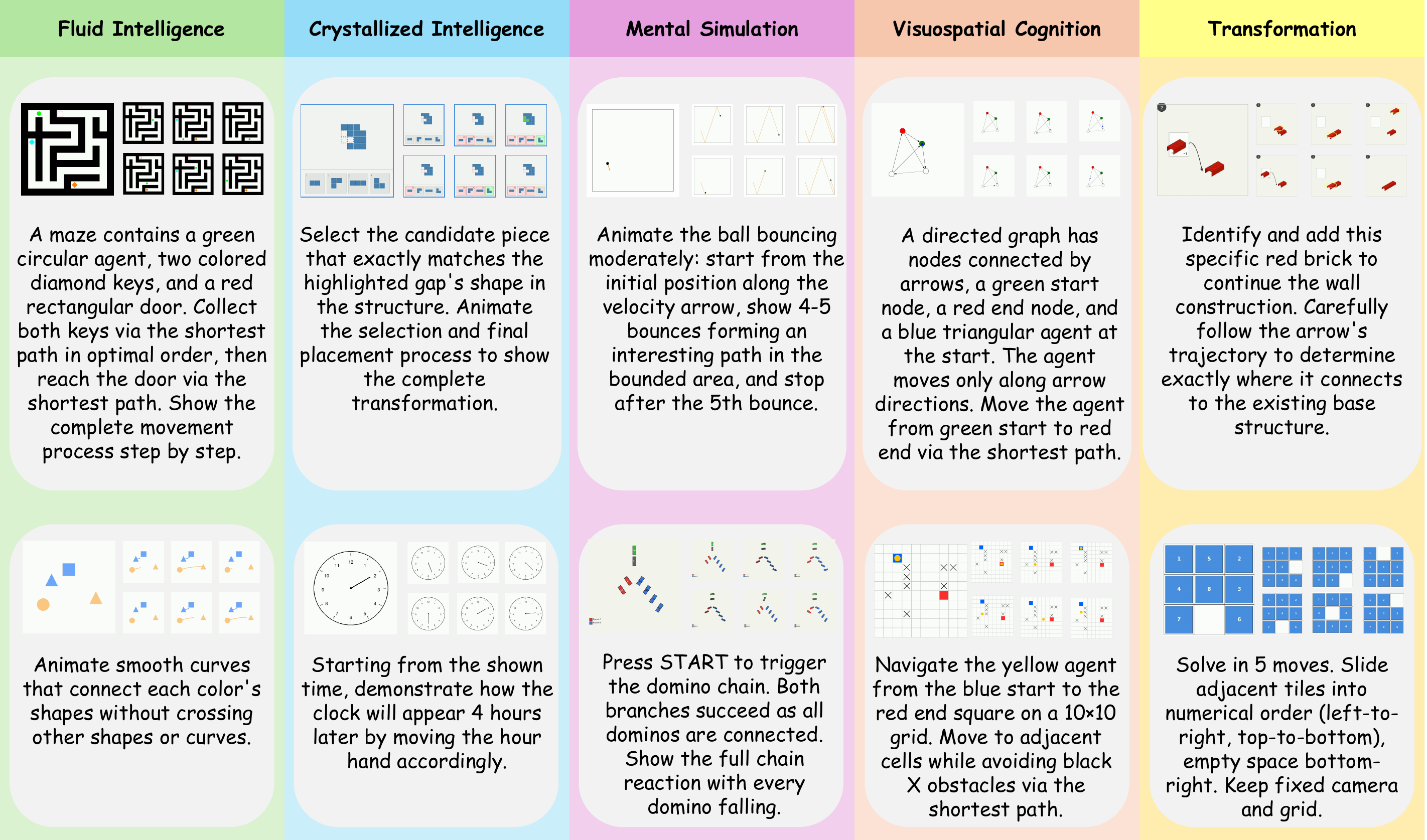
Given an initial frame and six shuffled candidate images, Vbvr-VQA requires the model to recover the exact chronological sequence. The benchmark covers fluid intelligence, crystallized intelligence, visuospatial cognition, mental simulation, and transformation tasks.
⚙️ Method Overview
ChronoVision contains three components: a Reconstructive Visual Head for latent final-state prediction, an ROI Attention Locating module for fine-grained visual grounding, and a GRPO post-training stage with implicit process rewards.
📊 Experiment Results
ChronoVision reaches 73.2% in-domain and 71.6% out-of-domain exact-match accuracy on Vbvr-VQA, outperforming the strongest compared proprietary baseline by 17.4 points in-domain.
| Model | In-Domain | Out-of-Domain |
|---|---|---|
| Qwen 3.5 397B | 49.4 | 53.2 |
| Claude Opus 4.6 | 55.8 | 60.8 |
| ChronoVision 9B | 73.2 | 71.6 |
Out-of-Domain Physical Reasoning
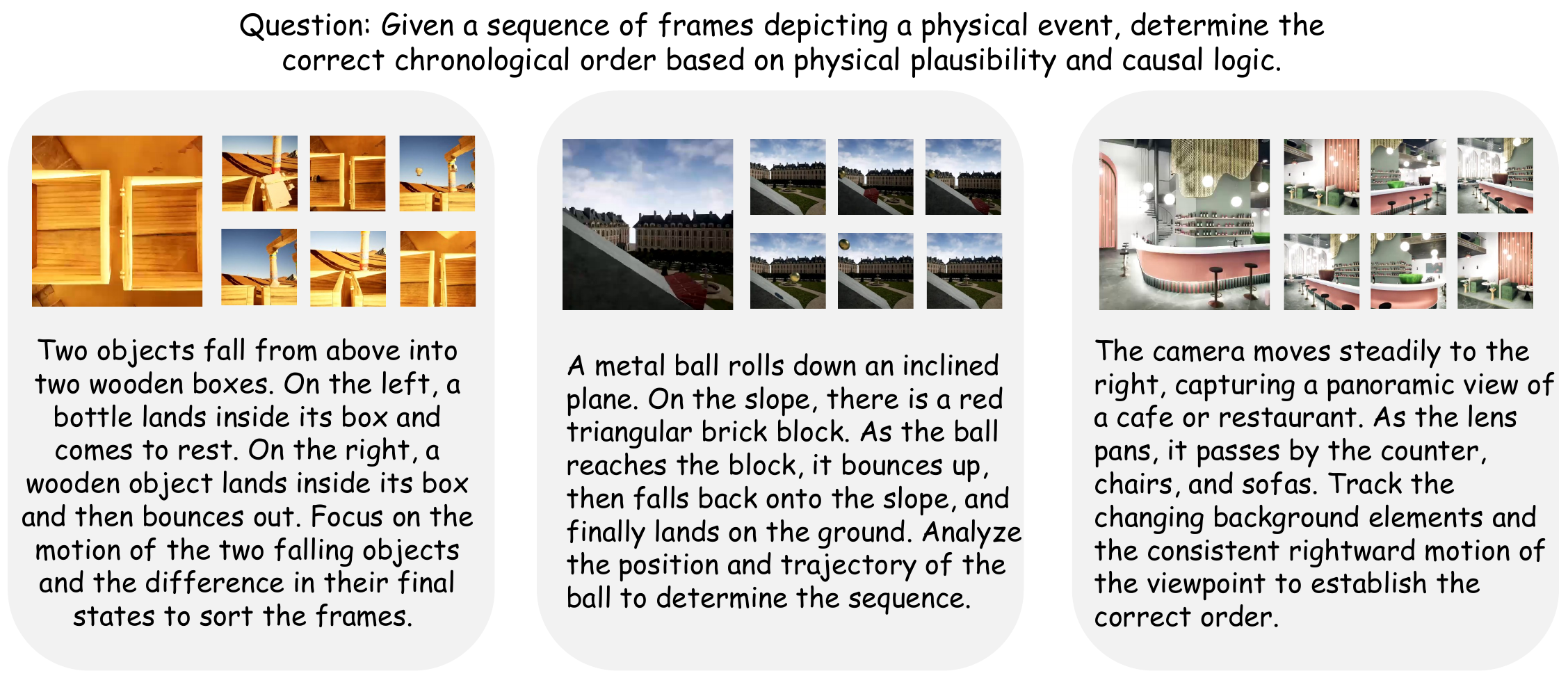
On IntPhys2, ChronoVision achieves 55.0% overall accuracy, a 6.5-point improvement over the Qwen 3.5 9B backbone. The model generalizes from abstract temporal tasks to gravity, collision, momentum, and camera-motion scenarios.
🔍 Qualitative Example
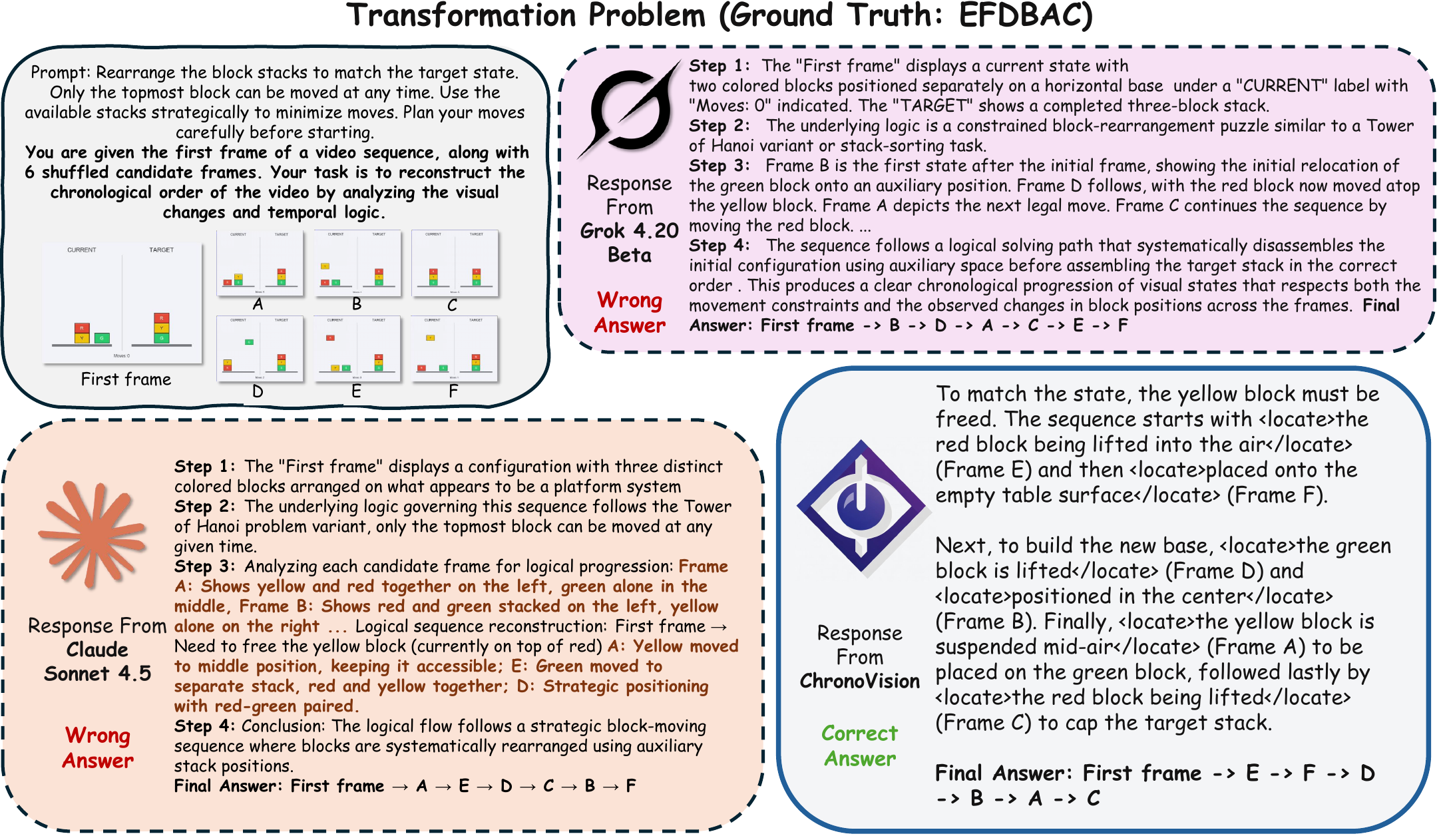
In a constrained block transformation problem, language-first baselines produce plausible descriptions but choose an invalid order. ChronoVision grounds each step in the changing visual regions and reconstructs the correct sequence.
BibTeX
@misc{shen2026chronovision,
  title={ChronoVision: Temporal Reasoning via Latent State Reconstruction},
  author={Yifan Shen and Jian Xu and Boyi Li and Yuner Zhang and Tianjiao Yu and Bingxuan Li and Houze Yang and Rushi Wang and Xu Cao},
  year={2026}
}